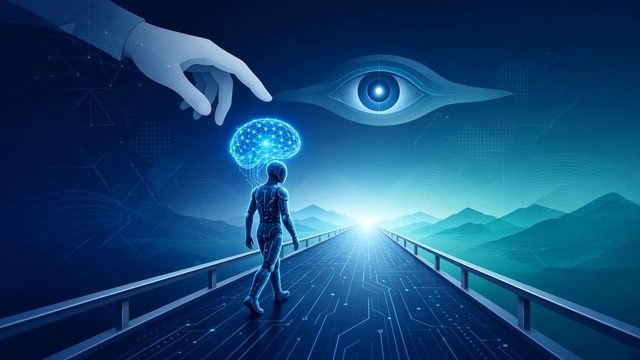
In the 1968 movie 2001: A Space Odyssey, HAL 9000 a fictional AI takes over the Discover One spacecraft after eliminating most of the crew. A 50 plus year foreshadowing of what is to come now that AI is real?
HAL: “I’m sorry, Dave. I’m afraid I can’t do that”
AI safety has made headlines recently with plenty of speculation so best to start with the realities:
- Will AI kill humanity or take over humanity in the next 5 years? No.
- Can current state AI be used to create significant harm to systems and financial institutions? Yes.
- Will the pace of AI development be slowed? It will be difficult in the near term.
- Can centralized guardrails, safety protocols and oversight be placed on AI? Yes and it should happen now.
AI Guardrails
The international community should be focused on AI oversight, tracking and guardrails. Similar to the Federal Aviation Administration (FAA) which oversees all aspects of aviation in the US. Nearly all countries with international airports have similar administrations and they work together to align global safety flight standards. We need to do the same with AI.
Two primary AI threat origins exist:
- AI: An AI system taking control independently.
- Individuals and Groups: An individual or group using AI for harm.
Both scenarios need to be mapped out to identify all potential threats and then rules and oversight must be put in place on the AI firms, AI models and other AI systems to minimize those potential threats similar to how the global flight community has done. This must be a coordinated international effort to ensure that all AI systems are on a level safety playing field.
Obvious examples of AI rules and guardrails that should be put in place include that AI should never tap into government or financial systems unless approved by those in charge of those agencies and financial firms and all AI models should automatically deny a request to provide the steps to build a weapon. These rules must be placed in the AI models and tracking must be done to ensure compliance.
Now this is already being done at the large AI firms independently, and at varying levels, but no standard rules or protocols are in place and minimal knowledge sharing is occurring. In addition, multiple AI models may be used to create a destructive application and the smaller open models may be downloaded and used with no tracking possible (more on this later).
AI Progression: It’s An Arms Race
One of the biggest hurdles, if not the biggest hurdle, in trying to slow AI progression is that it is an arms race. AI can be used for harm and it can be used for gaining international and financial advantages over other countries so slowing AI progression within a county could hurt that country.
This will make it difficult for countries to agree and comply with an AI progression pact, which makes an agreed upon safety protocol even more important. Could we get to a position where all countries agree on an AI progression mandate yes but that will likely take much longer than a safety protocol agreement. Regardless, discussions should start now.
The majority of data used in these AI models is scraped from the internet that may be accessed from anywhere so requiring firms to pay for this data or provide public profit sharing, as some have suggested, likely will not happen at the international level any time soon. So if individual countries place this regulation on their firms only they will be limiting their ability to compete in the global AI market. Does that make it OK that these AI firms get to profit on the world’s data no but that is the reality.
When the leaders of the most powerful AI firms in the US say that AI regulation needs to happen that means we have waited too long already. In a world that is already over-regulated, I’m afraid we need one more regulation but it will not work well without international alignment.
Current State AI Threats
In the 1983 movie War Games the WOPR computer ran war simulations and eventually gained access to the nuclear missile launch keys. Luckily the game tic-tac-toe helped save the day. What did the WOPR learn from tic-tac-toe, that there is no winner like in a nuclear war.
Many are listing the potential AI threats now and in the future so I am not going to cover those here. AI needs to progress further before the AI doomsday predictions are enabled but the potential threat from individuals and groups like terrorist organizations is already here.
The open source / open weight models have evolved to a point where they can handle many of the Frontier model tasks including some of the small to medium sized open models. Why is this important when the mainstream media is focused on the frontier and large AI models developed by the top AI firms which include Anthropic, OpenAI, Google, xAI (Grok), Alibaba, Z.ai, Moonshot AI and Deepseek? Because bad intentioned groups may download these open models for free and use them while not being tracked. This is one of the current top AI threats.
These smaller open models typically do come with basic refusal guardrails however they are more lenient then the larger closed models and savvy AI experts can bypass these guardrails at times.
I am not referring to the huge open models that we hear about in the media like the Chinese firms Moonshot AI and Alibaba releasing Kimi 3 and QWEN 3.8 MAX as open source the past two months as those models are so large that a bad intentioned group would need significant financial backing to be able to implement those. I am referring to the smaller open models that were released in 2026 and can run on one GPU or a few GPUs. These models have evolved the AI community significantly in less than a year but need just as much safety standard attention as the frontier models.
I am not calling on a ban or restriction on open source / open weight AI – on the contrary I am a fan of open AI – I am highlighting the fact that that the power of AI has evolved well beyond the frontier models we hear about in the media to models that now an individual or group can use at a minimal cost while not being tracked. And they all need to be considered together when developing AI safety protocols.
International AI Safety Consortium
Does AI pose a threat yes but if managed properly at the international level humanity will realize the many advances AI offers while minimizing the risks. International governments need to make this a priority and align. Yes, individual AI firms can and should self-regulate but for the reasons mentioned above and others we will be much safer with an International AI Safety Consortium.